Tell somebody that you're going to have a slice of cake fried in butter for breakfast, and they'll probably call your cardiologist for you. Tell them that you're going to have pancakes for breakfast, and they'll pull up a chair. Its all in the presentation.
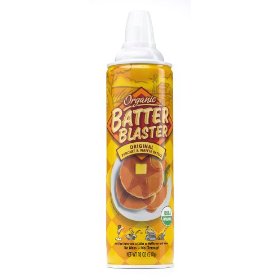
There are lots of shortcuts to pancakes. You can buy a mix, add some eggs, possibly some water and some oil, and make pancakes. Heck, you can even buy spray pancakes now!
 |
| Delicious, no? |
While you could make quick pancakes out of a can, and even possibly survive eating them, I've tried these. They're not food. Pancakes should be soft and pillowy.
Pancakes are assembled using what is called the 'muffin method'. In the muffin method, all of the dry goods are combined in one bowl, all of the wet goods in another bowl. Then the wet gets poured into the dry. I've read recipes that instruct the cook to add the dry to the wet. What happens when you do this?
 |
| Like this, but with more flour |
For the dry goods, we're using flour, baking powder, baking soda (double acting), salt and sugar. Usually sugar goes in with the wet goods, but we're making an emulsion with eggs later, and sugar likes to steal water away from things. So the sugar stays dry.
I weigh all of my dry ingredients. Its impossible to scoop out even cups of flour. Try it some time. Get a bag of flour, a 1 cup measuring cup, and a scale. Scoop out equal cups and weigh them. Chances are your amounts will vary by up to 20%. Weight, however is constant. And since grams are a smaller unit of measure than an ounce, I weigh everything in metric units. All of the dry goods get whisked together. I have yet to find a sifter that doesn't clog, make a mess and eventually lead me to a blinding, white-hot rage. So I use a whisk to get rid of any clumping and to evenly distribute all the dry stuff.
Next we start the wet ingredients. Melt half a stick (4 Tablespoons) of butter in the microwave and set it aside to cool. Crack 2 eggs into a medium bowl.
Eggs are incredible. The yolk is almost completely made up of fat and the white part (the albumen for you Jeopardy fans) is almost completely water. We all know that oil and water don't mix. Unless, of course you have an egg on hand. Eggs create emulsions that let us mix oils and water.
There's so much lecithin (the emulsifier) in eggs that we can add more fat and more water to the mix and it won't break. In our case, the 4 oz of melted butter and 2 cups of room temperature buttermilk. I can only find fat free buttermilk in our stores, but some day I will get the real stuff which still contains traces of butterfat. These additions are drizzled slowly while whisking and we get a homogenized emulsion. Which really sounds much more scientific than it needs to.
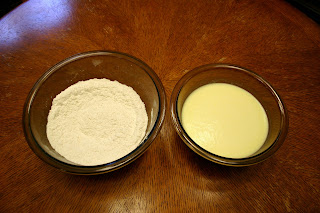
Do you wet goods take dry goods to be your lawfully wedded ... um ... Spouse?
 |
| Perfectly legal union in the state of NY. |
The wet goods, as we said above get poured into the dry goods
Now it's time to mix. The goal here is to mix things just until they come together. We don't need to get rid of every little lump. Overmixing will produce gluten. And while many fad diets will tell you that gluten is bad for you, and probably has led to the global recession, unless your doctor has told you to avoid it, the real reason we don't want gluten here is that it makes the final product chewy. We want pillowy, so mix just until things come together using a rubber spatula or a whisk. If you wanted to make additions to the pancakes such as fresh blueberries, chocolate chips, or toasted walnuts, nobody would hold it against you, and now is the time to do so.
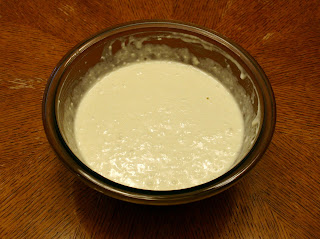
Yes, there are lumps. No, I'm not worried. The liquids will work their way into the flour as our batter rests. And rest it must! The batter should rest for a good 10 minutes or so. Not only to let the liquids disperse, but also to relax any gluten that we've formed (we can't avoid it all together), but also to let the acids in the buttermilk produce bubbles when they react with the baking soda and baking powder. This process, where bubbles develop is called leavening. And there's more to come.
While the batter is resting, melt a small amount of butter in a big nonstick pan, or on a griddle. Use a paper towel to rub the pan with the melted butter. We have a lot of fats in our batter, so we don't need a ton in the pan.
After the butter is melted and the batter is rested, it is time to cook. I use a disher to scoop the batter into the pan.
Cook the pancakes on one side until you see bubbles popping on the surface. Now that we've added heat to the equation, the baking powder is working again. If you look at your can of baking powder, it probably says, "Double acting" on it. The first leavening begins when the powder reacts with an acid. The second leavening happens when heat is applied. This is how we achieve thick, fluffy pancakes.
Carefully flip with a plastic spatula, and cook on the other side until golden brown.
Most likely nobody needs to be told how to serve pancakes. But just in case...
Ingredients
270 grams all purpose flour
42 grams granulated sugar
6 grams kosher salt
5 grams baking powder
4 grams baking soda
2 large eggs, beaten
4 Tablespoons butter, melted and cooled
2 cups buttermilk at room temperature


